Remote Control is on by default for everyone except Enterprise organizations.
Download the Cursor iOS app and sign in. Computers on your account appear in the app automatically. Tap your computer in the app and approve your pairing request in the Cursor desktop app. Your local agents appear in a list. Tap one to see what it's doing or send it a message.
Remote control doesn't move your agents anywhere. It keeps running on your computer, and the app connects to it. Your computer needs to stay on and online for remote control to work.
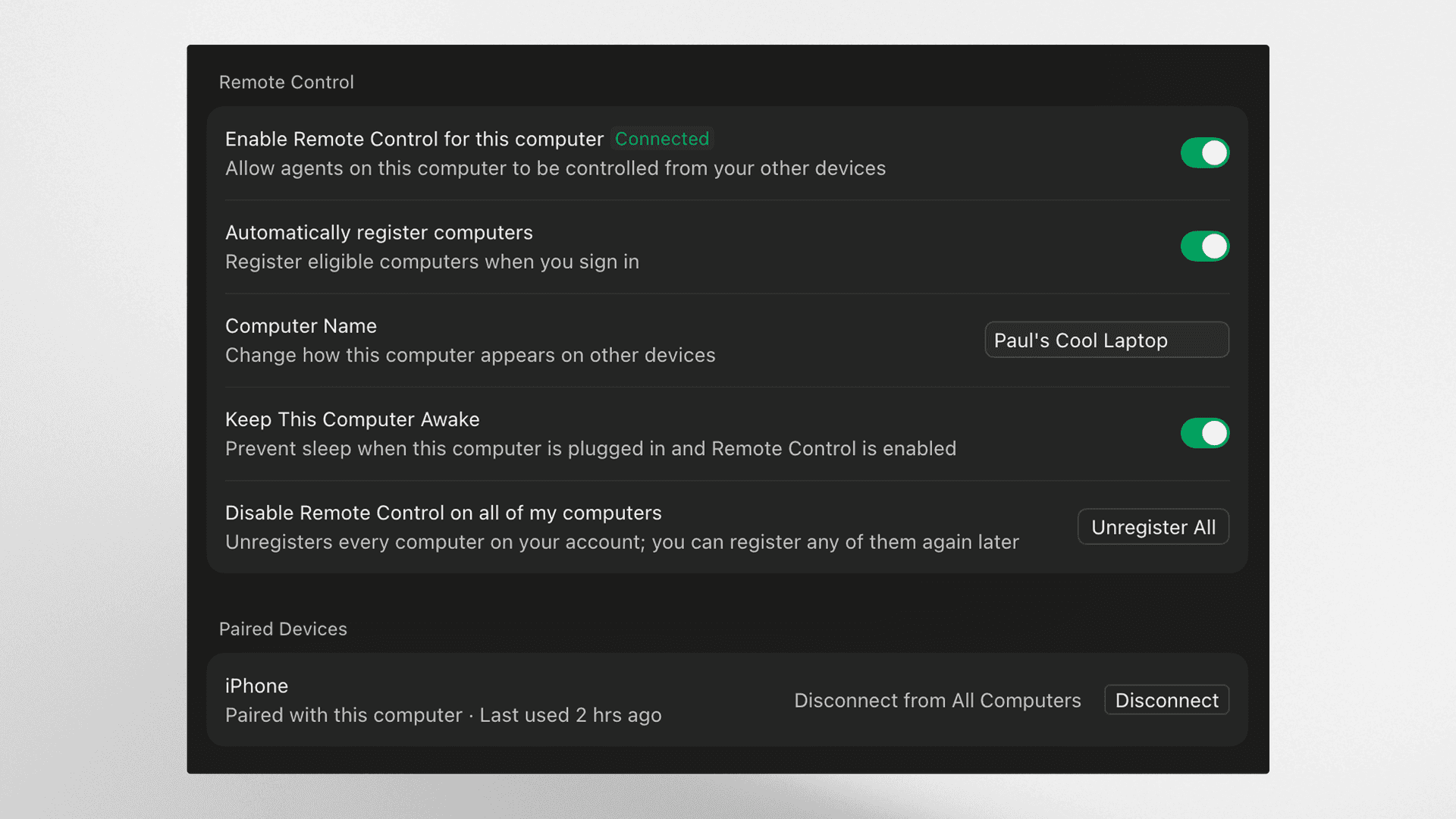
To stop your computer from sleeping while you're away, turn on "Keep this computer awake" under Remote Control in Cursor's desktop settings. Your computer needs to be plugged in with the lid open.
Remote control is on by default, except for Enterprise organizations. Enterprise admins can turn it on in Org settings > Security and identity > Remote control.
Remote control doesn't require cloud agents to work.
Remote control is available today in the Cursor iOS app.
Today we're launching two Cursor bots for the last mile of shipping code. Rollouts watches every change as it deploys and reports its health per environment. Security Review reports exploitable bugs on every pull request.
Both are available today on Teams and Enterprise plans.
Rollouts attaches a monitor to every pull request and watches the change as it deploys, reporting change health per environment: verified healthy, regression detected, or inconclusive. It's the Cursor version of Firetiger Change Monitors, rebuilt with the Bot Development Kit.
Enable it from the dashboard and connect source control, your deploy system, and your telemetry provider. Rollouts starts watching on the next pull request.
When a pull request opens, Rollouts reads the diff and the systems it touches, then writes a monitoring plan as a PR comment. The plan lists the risks it identified, the effect the change is meant to have, the signals it will check, and any gaps in instrumentation that would make the change hard to verify. Edit the plan in the PR and Rollouts uses your version.
Rollouts wakes on deploy events for the change's commit and runs the plan against your logs, metrics, and traces. It tracks each environment separately, so a change can be verified in staging and still flagged in production. Rollouts checks the change's intended effect alongside error and latency signals, and reports back on the PR when it reaches a verdict.
When Rollouts detects a regression, it names the change it suspects and notifies the author. Depending on configuration, it can also open a revert PR for review or hand the finding to a cloud agent for a fix. Rollouts does not merge or roll back on its own today.
Rollouts connects to Origin or GitHub for source control, to your continuous delivery system for deploy events, and to Datadog and other telemetry providers for signals. Feature flag integration is coming soon.
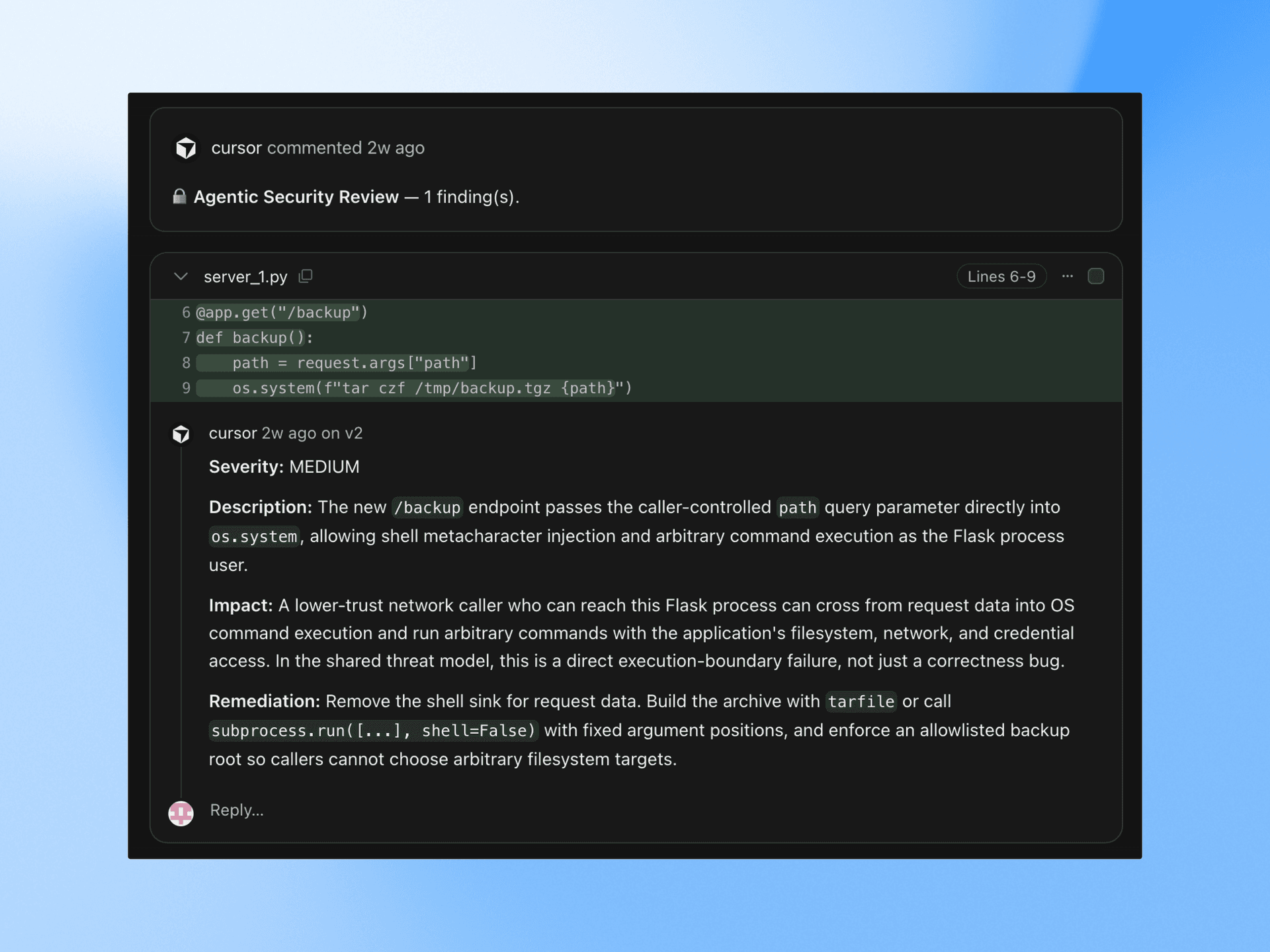
Security Review is available today. It reads every pull request in the context of the codebase and posts one review comment reporting exploitable bugs. Style and quality stay with Bugbot.
Enable it from the dashboard for the repositories you want reviewed. Draft PRs are skipped.
Security Review looks for injection across SQL, command, and template surfaces, along with authentication and authorization bypasses, including checks that a refactor stopped running. It also flags secrets and credentials committed to source, SSRF and unvalidated redirects, unsafe deserialization, and dependency changes that introduce known vulnerabilities. It traces where user input enters and what it passes through.
Add rules for your codebase, such as which client external calls must go through or which tables are never queried from a request handler, and Security Review enforces them on every PR.
Rollouts and Security Reviewer are available today on Teams and Enterprise plans. Enable either bot from the automations tab.
For the next 10 days, we're including usage credits so teams can try Rollouts on real changes. Teams and Enterprise customers receive credits for roughly 50 and 500 changes, respectively.
Today we're launching Projects in Cursor. Projects lets you take on larger bodies of work, such as a feature, a migration, or a full app. It maintains context over months of work, delegates tasks to thousands of subagents, and performs recurring work without being prompted.
Access Projects from the left-hand nav. The coordinator agent in a project doesn't write code itself; it plans the work, delegates it to agents that implement it, and brings the finished work back to you to check. Coordinators create and manage agents on your behalf, running as many in parallel as the work needs.
A Project runs on its own computer in the cloud, so closing your laptop doesn't stop it. When something needs testing on your machine, the coordinator spins up a local agent to run it there.
You shouldn't have to onboard an agent every time you start a task. Each Project maintains a set of files that sync across every cloud and local machine its agents use. Agents add research and artifacts, along with what they learn about the codebase and how you prefer work to be done. If one agent figures out how to test a service, for example, every future agent can use those instructions. The shared context grows with the Project, making the coordinator more effective over time.
Tell the coordinator agent to watch a Slack channel, run on a schedule, or follow all your PRs. This way it can take action based on signals it detects, without waiting for your prompt.
Connect Slack and point it at a bug-report channel, and it starts delegating each time a bug comes in.
Projects are available in beta and rolling out to all users starting today.
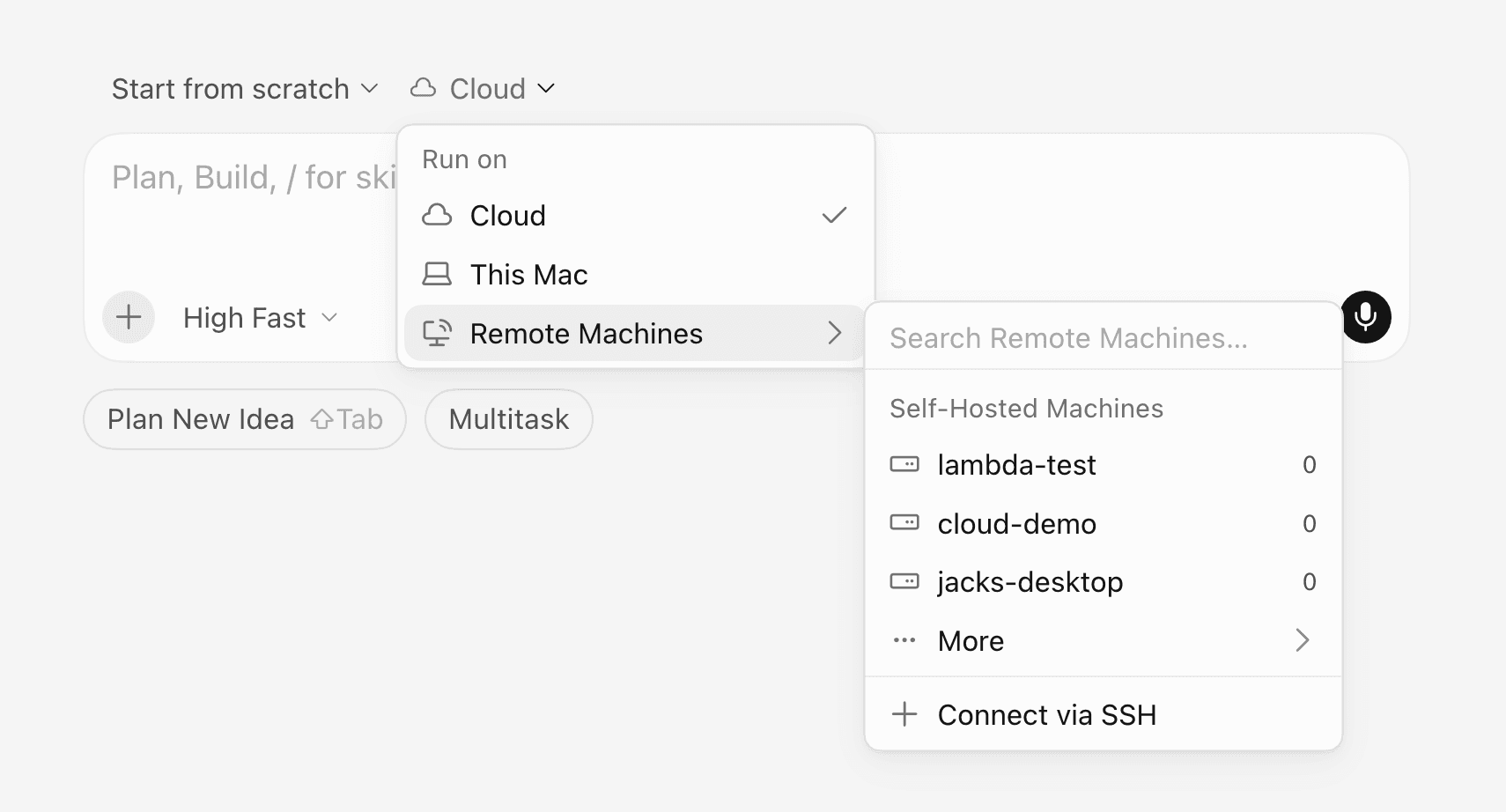
My Machines connects a single laptop or VM to your account for personal workflows.
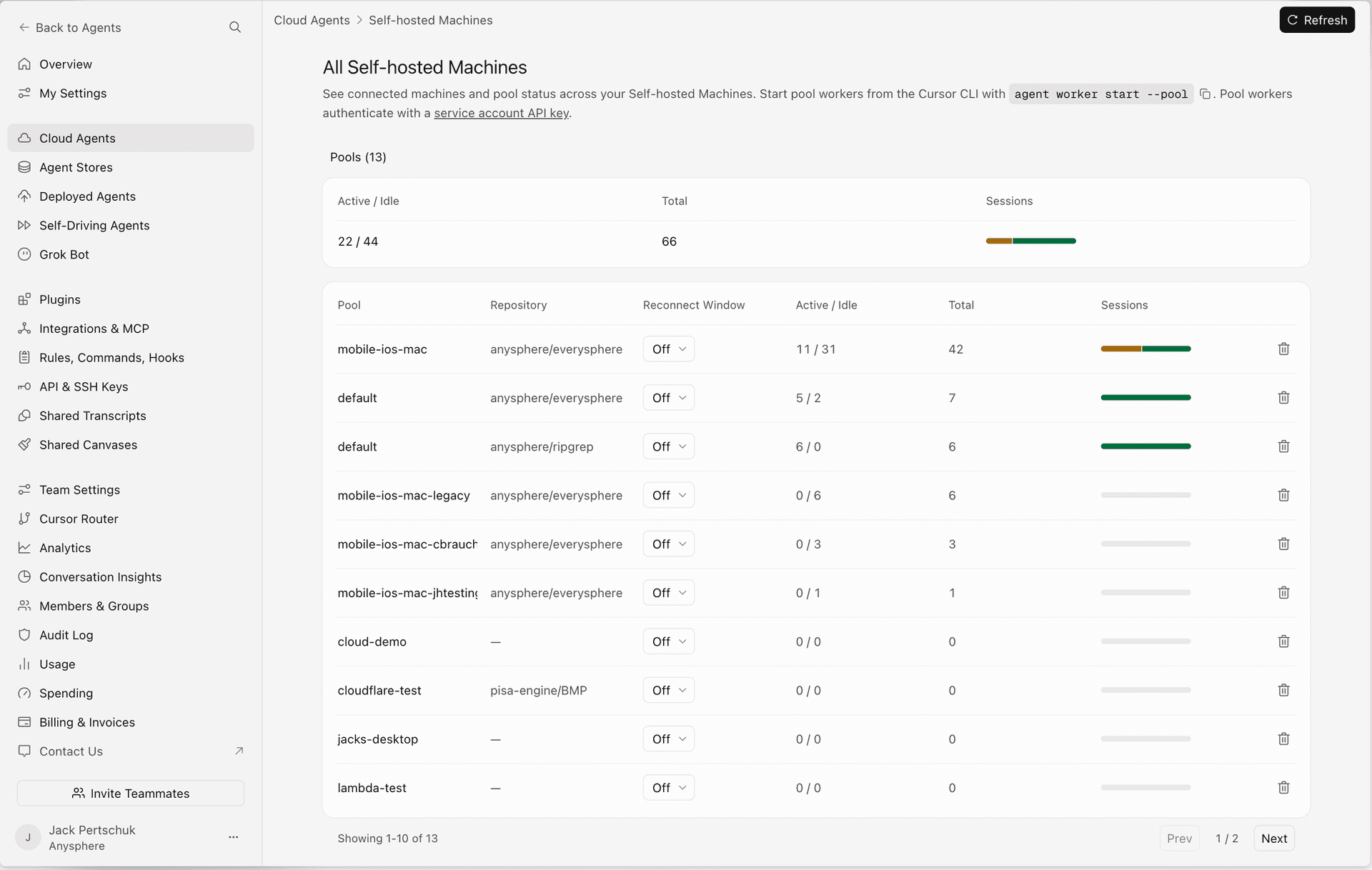
Team pools are named queues of workers for a team or enterprise. Capacity can grow as requests arrive and shrink when workers disconnect, so your self-hosted machines can scale with demand. Pools are not tied to one repository: name the pool, and any available worker can claim the request.
Pools can also hibernate idle machines, then restore within a reconnect window when a follow-up arrives, so you don't keep expensive capacity warm just for the next prompt.
Cloud agents can now execute on infrastructure you already use, including from AWS Lambda, Coder, Cloudflare, Daytona, Modal, Namespace, Vercel, and E2B.
Self-hosted workers now support computer use on Linux and Mac. With the right desktop packages, an agent can click, type, take screenshots, and drive the browser. You can watch its desktop or take control from Cursor.
Cloud Agents no longer require a connected GitHub or other third-party SCM provider to get started. Prompt from the get-go, then save your work to a Cursor Origin repo.
Once the agent's build is to your liking, click the Create repo button to save your work in an Origin repo. Choose a custom name or pick one of the suggested ones, then set the visibility to private or internal. You'll get a fully scaffolded Origin repo, ready to share or keep building on. Navigate to the Codebase tab to find your repo and access your project.
Remote Control is on by default for everyone except Enterprise organizations.
Download the Cursor iOS app and sign in. Computers on your account appear in the app automatically. Tap your computer in the app and approve your pairing request in the Cursor desktop app. Your local agents appear in a list. Tap one to see what it's doing or send it a message.
Remote control doesn't move your agents anywhere. It keeps running on your computer, and the app connects to it. Your computer needs to stay on and online for remote control to work.
To stop your computer from sleeping while you're away, turn on "Keep this computer awake" under Remote Control in Cursor's desktop settings. Your computer needs to be plugged in with the lid open.
Remote control is on by default, except for Enterprise organizations. Enterprise admins can turn it on in Org settings > Security and identity > Remote control.
Remote control doesn't require cloud agents to work.
Remote control is available today in the Cursor iOS app.
Today we're launching two Cursor bots for the last mile of shipping code. Rollouts watches every change as it deploys and reports its health per environment. Security Review reports exploitable bugs on every pull request.
Both are available today on Teams and Enterprise plans.
Rollouts attaches a monitor to every pull request and watches the change as it deploys, reporting change health per environment: verified healthy, regression detected, or inconclusive. It's the Cursor version of Firetiger Change Monitors, rebuilt with the Bot Development Kit.
Enable it from the dashboard and connect source control, your deploy system, and your telemetry provider. Rollouts starts watching on the next pull request.
When a pull request opens, Rollouts reads the diff and the systems it touches, then writes a monitoring plan as a PR comment. The plan lists the risks it identified, the effect the change is meant to have, the signals it will check, and any gaps in instrumentation that would make the change hard to verify. Edit the plan in the PR and Rollouts uses your version.
Rollouts wakes on deploy events for the change's commit and runs the plan against your logs, metrics, and traces. It tracks each environment separately, so a change can be verified in staging and still flagged in production. Rollouts checks the change's intended effect alongside error and latency signals, and reports back on the PR when it reaches a verdict.
When Rollouts detects a regression, it names the change it suspects and notifies the author. Depending on configuration, it can also open a revert PR for review or hand the finding to a cloud agent for a fix. Rollouts does not merge or roll back on its own today.
Rollouts connects to Origin or GitHub for source control, to your continuous delivery system for deploy events, and to Datadog and other telemetry providers for signals. Feature flag integration is coming soon.
Security Review is available today. It reads every pull request in the context of the codebase and posts one review comment reporting exploitable bugs. Style and quality stay with Bugbot.
Enable it from the dashboard for the repositories you want reviewed. Draft PRs are skipped.
Security Review looks for injection across SQL, command, and template surfaces, along with authentication and authorization bypasses, including checks that a refactor stopped running. It also flags secrets and credentials committed to source, SSRF and unvalidated redirects, unsafe deserialization, and dependency changes that introduce known vulnerabilities. It traces where user input enters and what it passes through.
Add rules for your codebase, such as which client external calls must go through or which tables are never queried from a request handler, and Security Review enforces them on every PR.
Rollouts and Security Reviewer are available today on Teams and Enterprise plans. Enable either bot from the automations tab.
For the next 10 days, we're including usage credits so teams can try Rollouts on real changes. Teams and Enterprise customers receive credits for roughly 50 and 500 changes, respectively.
Today we're launching Projects in Cursor. Projects lets you take on larger bodies of work, such as a feature, a migration, or a full app. It maintains context over months of work, delegates tasks to thousands of subagents, and performs recurring work without being prompted.
Access Projects from the left-hand nav. The coordinator agent in a project doesn't write code itself; it plans the work, delegates it to agents that implement it, and brings the finished work back to you to check. Coordinators create and manage agents on your behalf, running as many in parallel as the work needs.
A Project runs on its own computer in the cloud, so closing your laptop doesn't stop it. When something needs testing on your machine, the coordinator spins up a local agent to run it there.
You shouldn't have to onboard an agent every time you start a task. Each Project maintains a set of files that sync across every cloud and local machine its agents use. Agents add research and artifacts, along with what they learn about the codebase and how you prefer work to be done. If one agent figures out how to test a service, for example, every future agent can use those instructions. The shared context grows with the Project, making the coordinator more effective over time.
Tell the coordinator agent to watch a Slack channel, run on a schedule, or follow all your PRs. This way it can take action based on signals it detects, without waiting for your prompt.
Connect Slack and point it at a bug-report channel, and it starts delegating each time a bug comes in.
Projects are available in beta and rolling out to all users starting today.
My Machines connects a single laptop or VM to your account for personal workflows.
Team pools are named queues of workers for a team or enterprise. Capacity can grow as requests arrive and shrink when workers disconnect, so your self-hosted machines can scale with demand. Pools are not tied to one repository: name the pool, and any available worker can claim the request.
Pools can also hibernate idle machines, then restore within a reconnect window when a follow-up arrives, so you don't keep expensive capacity warm just for the next prompt.
Cloud agents can now execute on infrastructure you already use, including from AWS Lambda, Coder, Cloudflare, Daytona, Modal, Namespace, Vercel, and E2B.
Self-hosted workers now support computer use on Linux and Mac. With the right desktop packages, an agent can click, type, take screenshots, and drive the browser. You can watch its desktop or take control from Cursor.
Cloud Agents no longer require a connected GitHub or other third-party SCM provider to get started. Prompt from the get-go, then save your work to a Cursor Origin repo.
Once the agent's build is to your liking, click the Create repo button to save your work in an Origin repo. Choose a custom name or pick one of the suggested ones, then set the visibility to private or internal. You'll get a fully scaffolded Origin repo, ready to share or keep building on. Navigate to the Codebase tab to find your repo and access your project.